Washing machine limescale Malta: Why Your Appliance Fails Faster
Your Washing Machine Isn't the Problem. Malta’s Water Is.
Washing machine limescale Malta is one of the most common — and most expensive — hard water problems homeowners deal with. Most people don't connect it to the water until it's too late.
"They just don't make them like they used to."
In Malta, that feeling is especially common.
But the reality is usually much simpler.
Hard water quietly damages thousands of washing machines from the inside — long before people notice there's a problem.
In most cases, it wasn't a factory defect. The machine wasn't too cheap. It wasn't bad luck.
It was the water — quietly doing damage from the very first wash cycle.
What Hard Water Does Inside a Washing Machine
Every wash cycle runs hot water through a machine that was designed to work efficiently with normal mineral levels. In Malta, the water is anything but normal.
Malta has some of the hardest water in Europe. That means every litre of water running through your washing machine carries dissolved calcium and magnesium — minerals that behave completely differently once they're heated.
When water heats up inside the machine, those minerals start separating from the water and sticking to surfaces. Over months and years, they build up into hard limescale deposits — on the heating element, inside the drum, along the pipes, around the seals, and inside the pump.
You can't see it happening.
But it's happening every single time you press start.
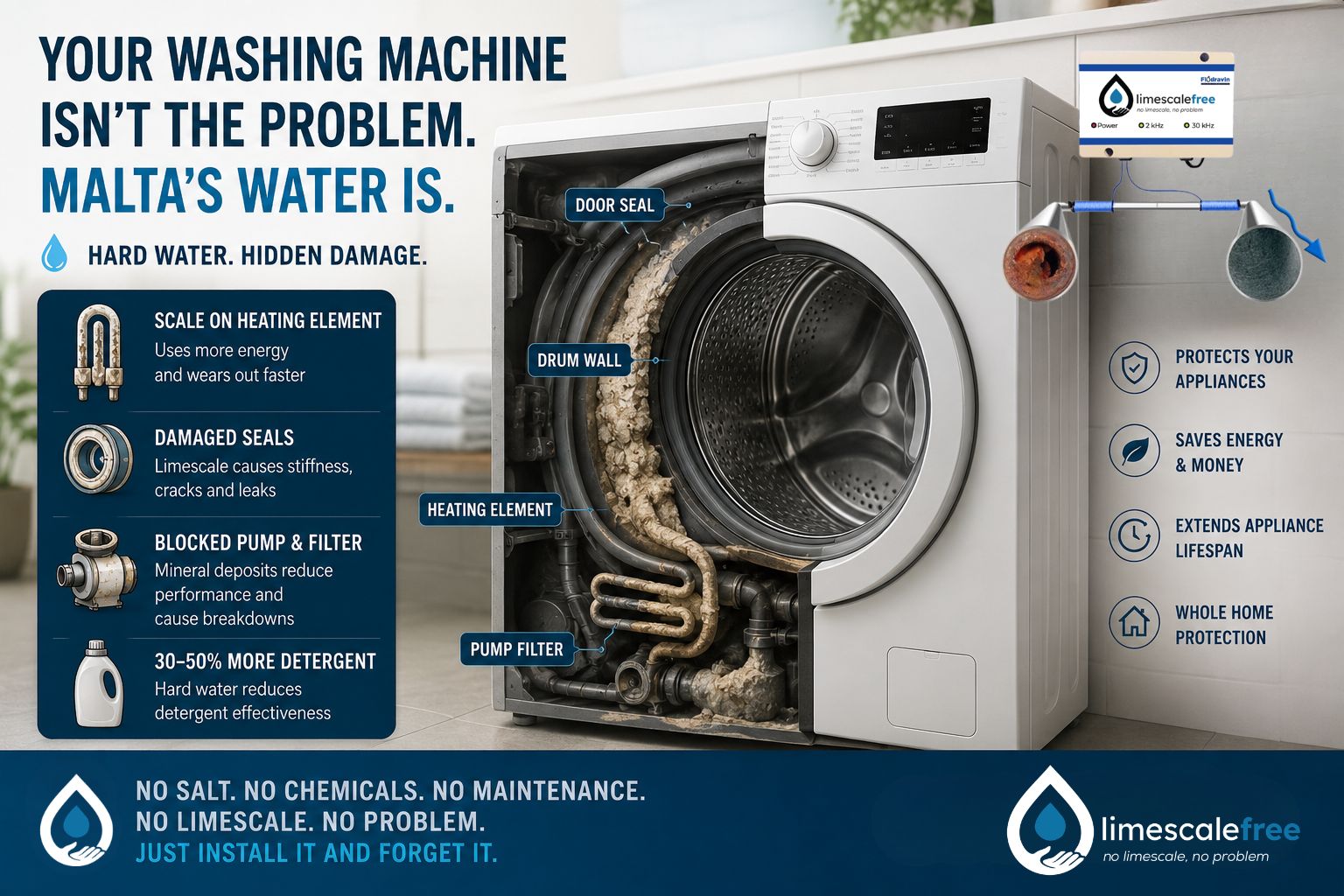
Washing machine limescale Malta: How the Damage Happens
The Heating Element
This is usually the first part to suffer.
Limescale acts as an insulating layer on the heating element. That means the element has to work harder and stay hotter for longer just to reach the same temperature.
Over time, that extra strain reduces efficiency, increases electricity usage, and eventually causes premature failure.
In Malta, heating element replacement is one of the most common washing machine repair jobs connected to hard water conditions.
The Drum and Seals
Hard water leaves mineral residue on rubber seals and inside the drum. Over time, seals become stiff, brittle and more likely to crack.
That eventually leads to leaks — something many people assume is simply part of owning an “old machine.”
The Pump and Filter
Mineral buildup and limescale fragments can accumulate inside the pump and filter, reducing water flow and increasing mechanical strain.
Eventually, performance drops and components wear out faster than expected.
Pipes and Internal Connections
Even the internal hoses and narrow water pathways inside the machine slowly collect scale buildup.
As these passages narrow, water flow becomes less efficient, wash cycles may take longer, and the entire machine operates under more stress than it was originally designed for.
Signs Your Washing Machine Is Already Struggling
Hard water damage usually doesn't appear as one dramatic failure.
It builds up slowly, through small signs that are easy to ignore:
- Clothes don't feel as clean as they used to
- The drum develops a musty smell even after cleaning
- The machine becomes louder or rougher during cycles
- Wash cycles take longer to finish
- Energy consumption slowly increases
- More detergent is needed for the same result
Hard water reduces detergent effectiveness.
In hard-water conditions, households often end up using 30–50% more detergent to achieve the same washing performance compared to softer-water regions.
That's not usually a detergent problem. It's a water chemistry problem.
What Hard Water Actually Costs Over Time
Most people only think about the cost of replacing the machine itself.
But the financial impact of hard water in Malta is much bigger than a single appliance purchase.
Heating element replacement: €80–150 parts + call-out
Pump replacement: €100–180
Early machine replacement: €400–700
Extra detergent usage over several years: easily hundreds of euros more
Higher electricity usage from reduced heating efficiency: ongoing, every month
And the reason most households never connect these costs to water is simple:
They don't appear all at once.
They quietly accumulate in the background over years.
Why Washing Machines Fail Faster in Malta
It's important to be direct about this:
According to the Water Services Corporation Malta, Malta’s tap water naturally contains high levels of dissolved minerals due to local limestone geology, groundwater conditions and desalination blending.
The result is water that is significantly harder than what most appliances are tested against in mainland Europe.
Appliances built and tested in countries like Germany, Italy or the Netherlands are generally designed around average European water conditions — not the mineral-heavy water many Maltese households deal with daily.
Even premium appliances can struggle under long-term hard water exposure in Malta.
That gap between “what the machine was designed for” and “what it experiences every day” is one of the main reasons appliances often fail faster than expected.
The Logical Solution: Deal With the Water, Not Just the Machine
When a washing machine breaks down, the natural response is to repair or replace it.
That makes sense in the short term.
But if the water conditions stay exactly the same, the next machine faces the same problem from day one.
Replacing appliances without addressing the water means the cycle simply repeats itself.
There are generally two approaches to dealing with hard water in Malta:
Traditional Water Softeners
Traditional softeners remove calcium and magnesium from the water using salt and ion exchange systems.
They can be effective, but they also require regular salt refills, maintenance, additional plumbing and ongoing operating costs.
Full comparison here: Water Softener vs Water Descaler
Electromagnetic Descalers
Electromagnetic descalers like Limescalefree work differently.
They don't remove minerals from the water.
Instead, they influence how minerals behave — making them far less likely to stick and form hard deposits inside appliances, boilers and pipes.
No salt.
No chemicals.
No maintenance.
No limescale, no problem.
Just install it and forget it.
The system is installed once near the main water entry point and works across the entire home.
- Washing machines
- Boilers
- Dishwashers
- Taps
- Shower systems
- Internal pipework
What Changes Over Time
Protection from limescale buildup isn't something dramatic you notice overnight.
The improvements usually appear gradually over weeks and months:
- Appliances operate closer to their intended efficiency
- Heating elements stay cleaner for longer
- Less detergent is needed
- Seals and moving parts experience less stress
- Fewer unexpected repair calls
- Cleaning becomes easier throughout the home
It's not about creating “perfect water.”
It's about reducing the long-term damage hard water quietly causes every day.
FAQ
Does hard water damage washing machines?
Yes. Hard water slowly creates limescale buildup inside washing machines, especially on heating elements, seals, pumps and internal pipes.
The damage usually happens gradually over years, which is why many people never realise the water itself is causing the problem.
Why do washing machines fail faster in Malta?
Malta has extremely hard water with high mineral content. Over time, those minerals form hard limescale deposits inside appliances.
That buildup reduces efficiency, increases strain on components, and often shortens the lifespan of washing machines compared to softer-water countries.
Can limescale increase electricity usage?
Yes. Limescale acts like insulation on heating elements, forcing the appliance to work harder and stay hotter for longer.
Even a relatively thin layer of scale can reduce heating efficiency and slowly increase electricity consumption over time.
Is a water softener the only solution?
No. Traditional water softeners are one option, but they aren't the only approach.
Electromagnetic descalers are also commonly used in Malta to reduce how strongly minerals stick and form hard limescale deposits — without salt or chemical treatment.
Does Limescalefree remove minerals from the water?
No. The system does not remove minerals from the water.
Instead, it is designed to change how minerals behave, making them far less likely to stick and form hard scale inside appliances, boilers and pipes.
Final Thought
If your washing machine in Malta is struggling, becoming noisy, or failing earlier than expected — the machine itself is usually only part of the story.
Hard water is a real and ongoing household problem in Malta.
It damages appliances, increases electricity usage, reduces efficiency, and quietly creates unnecessary repair costs over time.
The earlier you deal with the cause, the less money you spend managing the symptoms.
Read next:
How Hard Water Quietly Increases Your Household Costs in Malta
Why Boilers Fail So Fast in Malta
Stop Replacing Appliances Without Solving the Actual Cause
If hard water is damaging your appliances in Malta, protecting the next machine starts by addressing the water itself — not just replacing the appliance again and again.